Showing posts with label Copenhagen. Show all posts

Thursday, September 27, 2012

Turning Torso: the anchor of Vastra Hamnen


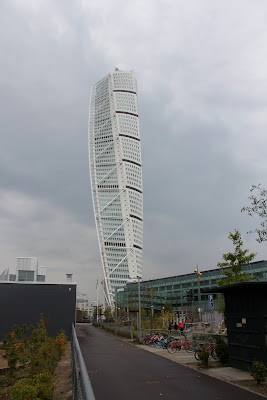
you can't spend several weeks in Malmo and not take pictures of the Turning Torso.  in fact, many would argue you can't spend several hours in Malmo and not take pictures of it.  you may even recall that I took a picture of it the first night I arrived in Malmo.  once the tallest apartment building in Europe, the Turning Torso twists upward 54 stories and 623 feet, the top floor at a 90 degree angle from the ground floor.  the Torso was envisioned by the government of Malmo as a new beginning, a fresh start, and a much needed strengthening of the skyline to the north of the city center.  it rises 2 times higher than Kronprinsen, the previous tallest building in Malmo.
turning torso by Santiago Calatrava
the Turning Torso approached from the southern main access road to Vastra Hamnen from the city center.  the Torso, designed by Santiago Calatrava, rises 623 feet and 54 stories.
the Kockums crane (Kockumskranen) which was sold to a Korean company in the early 2000's was the last and highest symbol of the working class city of Malmo's shipbuilding industry.  it's last duty was to assist in the building of the Oresund Bridge, the lifeline connection between Copenhagen, Denmark and Malmo, Sweden.
looking up
looking up at the Torso from the street
in the years leading up to the decision to construct the Turning Torso, there were three major focused objectives of the city of Malmo, partly in an effort to move forward after the financial collapse caused by the shipbuilding industry abandoning the city (among other financial challenges), partly to jump into the 21st century, and partly to recreate and rebrand the city and its identity.  the three objectives were, at first blush, quite simple:

  1. improve education and heighten the focus of the city on advanced education
  2. strengthen connectivity and interconnectedness of Malmo within the region of Skane and beyond
  3. use sustainability and sustainable initiatives as a method to advance the city and its planning

these three objectives were simultaneously addressed starting in the 1990's and moving into the first decade of the 21st century.  though the Turning Torso was not, in itself, a cornerstone of any of these three specific objectives, it played a significant role as a new symbol of Malmo, the city of the future.  the Torso is an excellent example of how cities use architecture (tall, unique, or important buildings, often designed by famous architects) to promote an agenda and "put themselves on the map" as Malmo has been doing for the last 15-20 years.
the tallest building in malmo
Turning Torso in Vastra Hamnen, Malmo as seen from the neighborhood
the three most obvious physical manifestations of the three objectives are quite powerful, and together have helped shaped Malmo as a growing, changing city with an eye toward the future.

1.  one of the brightest examples of the city of Malmo putting a new focus on higher education was the creation of Malmo's first University, Malmo Hogskola.  the University, now a central hub of the Dockans neighborhood adjacent to the central train station and Vastra Hamnen, has grown to more than 24,000 students in just over ten years of operation (the school opened officially in 1998).  the school has many disciplines and areas of study, including several in sustainability such as master's degrees in "Leadership for Sustainability" and "Sustainable Urban Management".
structural expressionism
the style has been called "structural expressionism" and is most evident in the exposed structural elements on the building exterior 
2.  the most obvious physical manifestation of the idea of interconnection in Skane and beyond is the Oresund Bridge and the improvements in the train transportation into Malmo.  the Oresund Bridge, completed and opened in July 2000, has created amazing opportunities for growth in Malmo as well as the opportunity for people living in Malmo to commute easily to Copenhagen.  besides the construction of the bridge itself, Malmo created new and improved train stations and rail lines from the bridge through the city center (called the City Tunnel Project) that simplify, enhance, and speed up travel to and from Malmo as well as through it up the western coast of Sweden and beyond.
green sustainable grocery store in the adjacent parking garage
the Turning Torso sits in a pool of water at the base (the parking complex in the background contains a sustainable grocery store and restaurant on the ground floor)
3.  in terms of sustainability, the list, as you may have seen from earlier entries in this blog, is endless.  I would argue that the most notable catalyst for the physical manifestation of making sustainability part of the city's future is Bo01, brought about as part of the European Housing Exposition in 2011, and evidenced in the European Village as well as the surrounding neighborhood and corresponding infrastructure.  this neighborhood, anchored on one corner by the tallest building in Scandinavia, is a beacon of hope for the future of sustainable cities and neighborhoods.
the top twists 90 degrees from the base
the Turning Torso as seen from the neighborhood school.  the top is 90 degrees twisted from the base.

Wednesday, September 19, 2012

Copenhagen bike share

Stockholm bike share locking mechanism where bike locks to stand
bike slot #18 at a bike station.  you can see the two access points that lock the bike front basket frame into the bike stand to secure the bike.  red light indicates that the bike is locked.  after swiping the card this little light turns green and the bike is unlocked and can be picked up off the stand.

the Copenhagen bike share has been on my list of "things to see" long before I knew I was coming to Sweden/ Malmo/ Scandanavia/ Denmark.  the Copenhagen bike share, started in 1995, was successful many years before Paris, Barcelona, and even Boston jumped into the fray. though it was not the first bike share program in the world, it was the first large scale, "free" city system that had unique bikes (parts could not be easily interchanged with other bikes).  unlimited bike use for a small deposit, bike stands throughout the downtown area, and a strict boundary of where the bikes could be used (police fine bike users if caught outside downtown city limits) factored into making the system a huge success.
copenhagen bike share bike
Copenhagen bike share bike lying in the street.  maybe the borrower of this bike went into the lego store?
I couldn't wait to try it out when Devo (visiting for a long weekend from Paris) and I hopped the train to Copenhagen.  in fact, we went directly to the tourist info location near Tivoli and the Central Train Station to get a map and break down some bills to the 20 kroner coins that one needs to unlock the bikes.
key is released by a 20 kroner danish coin
key that keeps bike locked.  to release the key the user inserts one 20 kroner coin.  once the coin has been inserted, the key pops out and the bike is free to roll.  upon returning the bike, the user inserts the key and the 20 kroner coin pops out and the key holds the bike locked.
we should have known from the start that getting onto the bikes would be easier said than done.  when talking to the woman at the tourist center we were handed our first clue of what was to come.  "good luck finding one," she said when we asked about the bike share, "you're better off renting a bike."  undeterred we bought a Danish (yes, this is where they come from) to create two of the necessary 20 kroner coins to unlock the two bikes.
no bike share bikes are here.  instead there are regular bikes locked to the rack
bike share bike rack in popular square in Copenhagen.  all of the bike share bikes are gone and regular bikes are locked in their place.  you can see the chain with the key at the end dangling down to the cobblestones.
as we walked through the city, we realized that the bike share locations are nothing more than simple nondescript metal racks that look pretty much like any other.  one of the reasons that we had trouble finding them is that there are no signs, every one we found was devoid of bike share bikes and instead were surrounded by normal bikes locked where the share bikes would have been.
front of Copenhagen bike share bike
Copenhagen bike share bike locked via chain to the rack.  each bike comes with a map showing the boundary inside which the bike must be kept (or the user is fined by police).  notice the (incorrect) silver coin sticking out where the 20 kroner coin should be inserted to release the bike.  this bike cannot be freed from the rack due to the improper coin blocking the path for the correct coin to release the key.
we gave up the search for bikes because we were having no luck, but continued walking the city and enjoying the pedestrian streets, amazing people watching, monuments and beautiful buildings, and general scene (the neighborhood was very crowded with everyone from locals to tourists to street performers).  we wandered, checking out the amazing surroundings and enjoying the freedom of the Copenhagen city streets.
bike rack, 20 kroner coin, and key connect together to secure the bike when not in use
inserting 20 dkk into the locking mechanism to release the key (top) that frees the bike to be ridden.  the chain in the picture connects the key to the bike rack and dangles freely once the bike is released.
of course as soon as we gave up looking for a bike rack with share bikes on it, we found one.  five bikes locked up on one single rack off the beaten path from the busiest pedestrian street, near the state house, stock exchange, and one of the main canals downtown.  jackpot.
turns out they were either locked improperly, broken, or otherwise unusable
five bike share bikes all locked to the rack on a street near downtown.  jackpot.  or maybe not...
again it should have been obvious that it was too good to be true.  two of the five bikes were locked together by a personal lock which basically means the bikes were no longer shareable and could only be used by the j#*ks (jerks) who decided that sharing is not caring.  so those two were out.  the next bike opened up successfully by sliding the 20 kroner coin into the slot and releasing the key and freeing the bike.  but (sad face) the last two bikes had been jammed with the wrong size coins and these coins were stuck, preventing either removing the existing coin or freeing the key and taking the bike.
key released by adding a 20 dkk coin
after adding the correct 20 dkk coin, the key releases, freeing the bike
the lesson here to me is that the free bike share system with a low entry fee (20 Danish kroner is less than $4 American) allows for the user group to not respect or take responsibility for the bike and the system itself.  I agree with the low entry fee and support the idea that everyone can use the bike(s), but the result is that most available bikes are either being improperly used or are in use and not available.
coin released after key is reinserted
once the key is reinserted, the coin pops free from the bottom
one could argue that the Boston share program (called Hubway) has its own problems, but the system works effectively and does not have the same problems as the Copenhagen one.  the Boston system, like many newer ones across the globe, requires a credit card to borrow a bike.  this makes the system no longer anonymous.  in addition to the credit card identifier making each borrower accountable, each bike is "checked in" when returned to the rack via a click digital connection point, ensuring that bikes are returned and also allowed for the system to know where all bikes are located.  this check in system allows a simple iphone app to tell users where there are bikes to pick up and where there are empty spaces to return the bike.
inaccessible bike share bikes locked together
two Copenhagen bike share bikes locked together with personal lock, making them inaccessible to regular people
the Boston system just completed it's first full year to rave reviews and membership was, for the first year, above predictions.  hopefully it will continue to be a success and build upon what has come before it, including the Copenhagen bike share, one of the first of its kind anywhere on the globe in 1995.

for more info on: